
Every team has a backlog it will never finish. Not because the team is not moving fast, but because there is always more worth doing than time to do it.
The small bug that annoys users but never makes the sprint. The tech debt everyone agrees on and nobody schedules. The routine change that takes an afternoon nobody has. These items pile up, and they quietly cost more than they appear to.
We built Arnold to take them on. Not as a tool your developers have to drive, but as a teammate that works in the same board, follows the same process and answers to the same people.
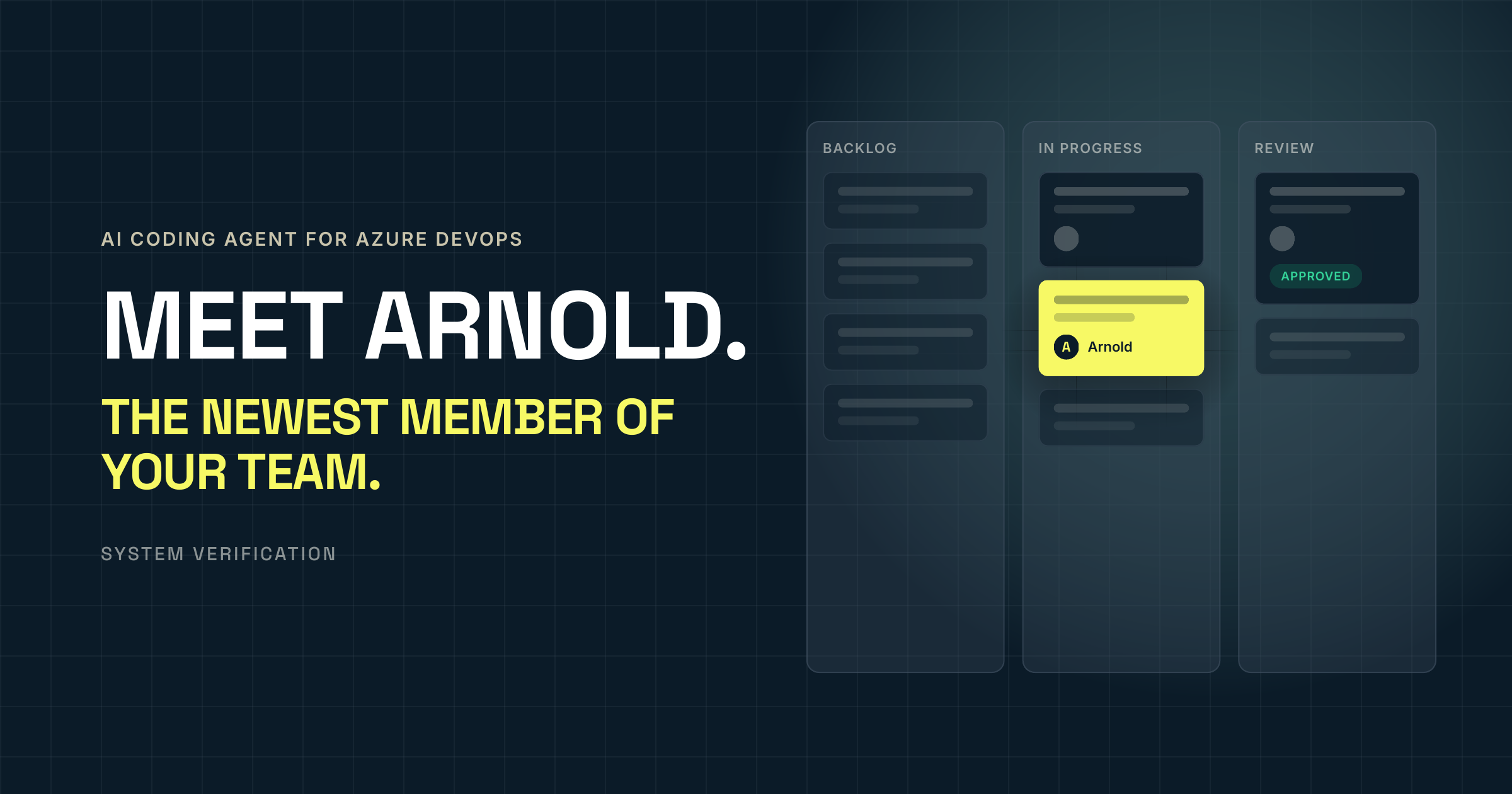
An agent that works like a teammate
Arnold is a coding agent that joins your team in Azure DevOps. It does not live in a separate tool or a chat window. It lives on your board.
- Arnold goes through the backlog, picks up items it can handle and assigns it to itself, like anyone else on the team.
- It develops the change and deploys it to a test environment.
- It opens a pull request that runs through your normal pipeline: code quality, static analysis, test coverage.
- A developer or tester reviews the result and decides. Nothing is merged without that decision.
There is no new process to learn. If your team knows how to work a board and review a pull request, it already knows how to work with Arnold.
Speed is only useful if you can trust it
AI can write code faster than any team can review it. That is not automatically a gain. Without control, it just moves the risk downstream.
So Arnold gets no shortcuts. Its code goes through the same pipeline and the same quality gates as everyone else's. If a change fails a check, it does not move forward. Before a change reaches a person, it has already been reviewed by an agent, so the human review is spent on the decision, not on catching basics.
And the final call is always human. A developer or tester approves every change. Arnold adds capacity to the team. It does not take accountability away from it.
Testers stop just finding bugs. They start closing them.
The biggest change is not for developers: it is for those who always had to lean on developers to get anything done. Roles like product owners or testers just got a superpower.
Today, a tester finds a bug, writes it up and waits. With Arnold, the same tester can hand the bug to Arnold, see the fix deployed in a test environment and verifys it the same day. The loop that used to cross several people and several sprints shrink to fit into a single day.
Developers gain too. Less time on repetitive changes and less context switching means more time on design, complex problems and review. The work that actually needs their judgement.
Arnold fits best where the work is well defined:
- Bugs found in testing, fixed by Arnold and verified by the tester
- Small backlog items and tech debt that never reach the top of the list
- Routine maintenance and simpler, clearly scoped tasks
One in five, and counting
Arnold is not a lab experiment. It is already working in a production team.
In the first team, Arnold now handles about one in five of all closed work items. Every one of them went through the same pipeline and was approved by a person on the team.
The next goal is two in five in the same team. That is not a promise about speed. It is a measure of how much routine work a team can hand over while keeping full control of what ships.
More hands on the backlog. Same hands on the wheel.
The question is not whether AI can write code. It can. The question is whether your team can trust what it delivers, and stay in charge of it.
Arnold is our answer: More of the backlog gets done and people stay in charge of what ships.
Want the short version to share with your team? Download the Arnold one-pager (PDF) for how it works, what it fits and the results so far. Or get in touch and we will look at what Arnold could take off your backlog.
Want to learn more?